How to Speed Up a Slow Elementor Website in 2026
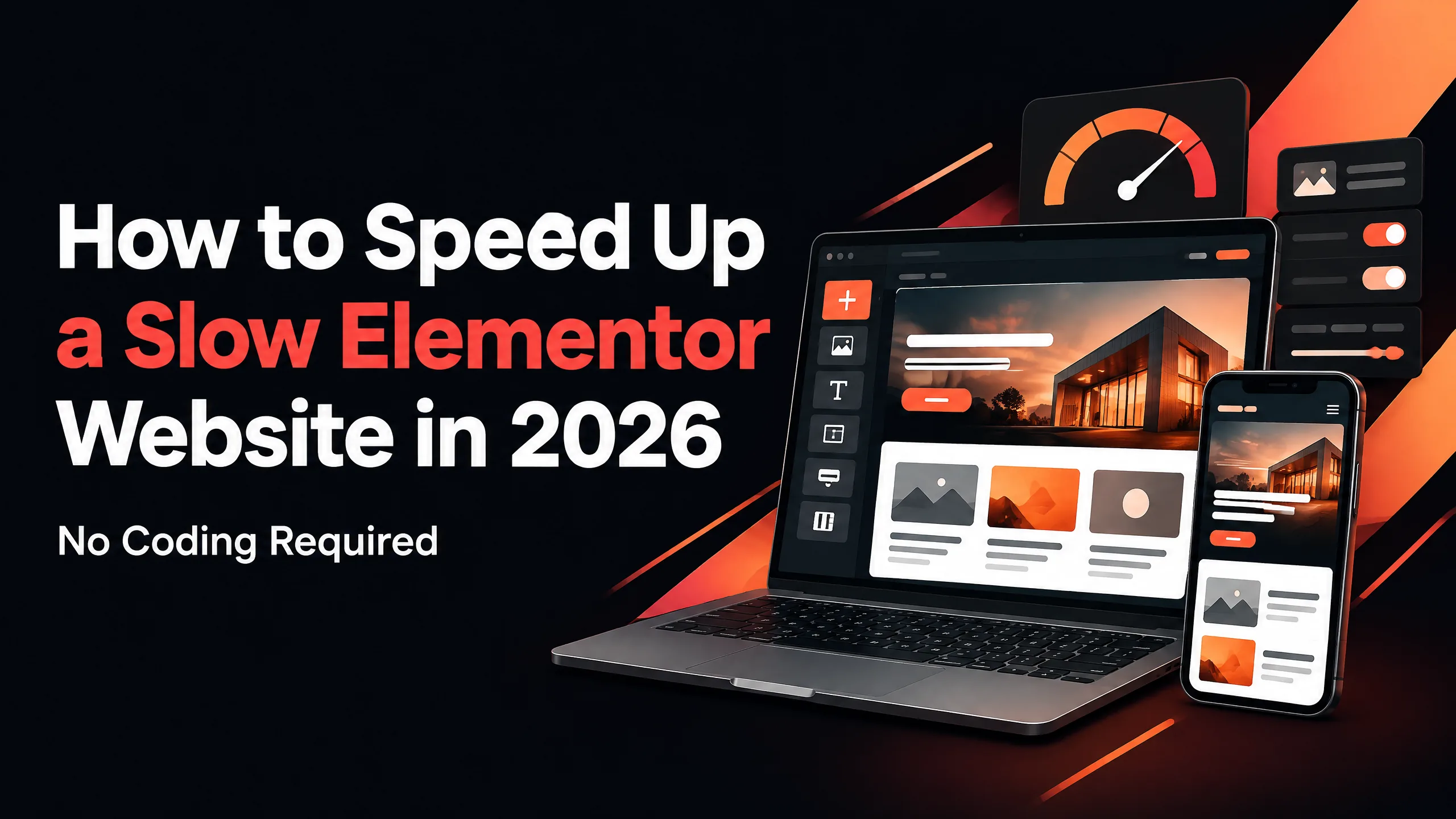
How to Speed Up a Slow Elementor Website in 2026 — a branded visual for a no-code website performance guide.
A slow Elementor website usually reveals itself in small, annoying ways. The logo appears, then the hero section takes its time. A menu opens late on a phone. A contact form looks ready but still has not finished loading.
When I check a slow WordPress site, I do not begin by switching on every performance checkbox. I open the page on a phone, test it in a private window, and look for the first thing that is making the visitor wait. A large hero image needs a different fix from a slow server response. A plugin conflict needs a different fix from an overbuilt Elementor layout.
Many of these fixes can be completed without writing code. The useful part is knowing what to change, what to leave alone, and how to test the page after each change.
First, test the page before changing anything
Do not judge website speed only by opening the page once on your own laptop. Your browser may already have the files stored in its cache. A first-time visitor is not getting that advantage.
Start with a representative page, such as your homepage or the service page that receives the most visitors. Test it using Google PageSpeed Insights. Run the test on both mobile and desktop, and note the results before making changes.
Pay attention to these areas:
- Largest Contentful Paint (LCP): how quickly the main visible content loads.
- Interaction to Next Paint (INP): how quickly the page responds to an interaction.
- Cumulative Layout Shift (CLS): whether content moves unexpectedly while the page loads.
- Total Blocking Time (TBT): a useful laboratory signal that can reveal heavy JavaScript work.
- Time to First Byte (TTFB): how quickly the server begins responding.

A slow Elementor website is usually diagnosed in stages: check the visible loading experience, then review images, scripts, caching, and server response time.
A score is useful, but it is not the whole diagnosis. Record the warnings and identify which file, image, script, or server response is responsible for the delay.
1. Resize and compress large images
Images are one of the most common reasons an Elementor page feels slow. A page may look simple in the editor but still download a large background image, several full-size photos, and multiple decorative graphics before the visitor can see the main content.
Before uploading an image, resize it close to the size at which it will appear. A banner that is displayed at about 1,600 pixels wide normally does not need to be uploaded at 5,000 pixels wide. Use a modern format such as WebP where it is supported, and compress the file without making it visibly blurry.
Check these image locations carefully:
- The hero or banner section.
- Full-width background images.
- Image carousels and galleries.
- Testimonials and team-member photos.
- Logo variations and decorative icons.
- Images inserted inside pop-ups or hidden sections.
Do not lazy-load the main image that appears immediately at the top of the page. The browser should be able to request important above-the-fold content quickly. Images further down the page can usually be lazy-loaded.
2. Remove images and sections that the page does not need
Elementor makes it easy to duplicate sections while designing. Over time, an old section may remain hidden on desktop but still add markup, styles, or background assets to the page.
Open the page in Elementor and review unused sections, duplicate layouts, old sliders, and hidden widgets. If a section is no longer required, delete it rather than hiding it. If you need different content for mobile, keep the layout as simple as possible instead of maintaining several large duplicate versions of the same design.
A shorter page is not automatically faster, but every unnecessary widget gives the browser more work to do. Remove anything that does not help the visitor understand the page or take the next useful action.
3. Keep Elementor layouts simple
Nested containers, large icon lists, animated counters, sliders, video backgrounds, and third-party widgets can increase the amount of HTML, CSS, and JavaScript that the browser must process.
This does not mean every Elementor page must be plain. It means visual effects should have a reason to exist. A static image is usually lighter than an autoplay background video. A simple call-to-action button is usually lighter than a carousel containing several slides and custom scripts.
Review the page for:
- Multiple sliders doing the same job.
- Autoplay background videos.
- Excessive entrance animations.
- Widgets loaded from external services.
- Repeated columns used only for spacing.
- Large icon libraries when only a few icons are visible.
Keep the important content near the top of the page and move optional details lower down. This helps visitors reach the main message sooner.
4. Check Elementor performance settings
Elementor includes performance-related settings that can reduce unnecessary output on supported versions. The exact names and location may change as Elementor updates its interface, so check the current settings available in your dashboard rather than copying an old screenshot blindly.
Look for performance features related to improved asset loading, optimized markup, lazy loading, caching, and reduced CSS or JavaScript output. Enable one meaningful change at a time and test the front end after each change.
Do not activate every experimental option at once on a production website. A performance setting can interact with a theme, cache plugin, form, animation, or third-party widget. If a layout breaks, you need to know which change caused it.
5. Use one caching approach
Caching allows the site to serve a prepared version of a page instead of rebuilding every part of it for every request. A suitable caching plugin can also help with browser caching, CSS delivery, JavaScript loading, and cache preloading.
Choose a caching solution that matches your hosting environment. For example, a LiteSpeed-based host may provide server-level features through LiteSpeed Cache, while another host may recommend a different solution. WP Rocket and other caching plugins may also be appropriate, depending on the setup.
Avoid installing two plugins that perform the same caching and minification tasks. Conflicting cache settings can create broken layouts, stale pages, or scripts that stop working.
After changing cache settings:
1. Clear the plugin cache.
2. Clear any host or CDN cache.
3. Open the page in a private browser window.
4. Test the menu, forms, buttons, pop-ups, and responsive layout.
5. Run the speed test again.
A faster score is not useful if the contact form no longer sends enquiries.
6. Reduce unnecessary plugins and third-party scripts
A plugin does not become harmful simply because it is installed. The problem is that some plugins load files across the entire website, even when their features are used on only one page.
Review plugins that add sliders, pop-ups, analytics, chat tools, social feeds, maps, animation libraries, or custom widgets. Ask whether each tool is still needed. Remove unused plugins completely instead of leaving them disabled indefinitely.
Third-party scripts deserve special attention because the browser may need to connect to another server before the feature becomes available. Load optional marketing and chat tools only when they are needed, and check whether a script is delaying the main content.
If you are unsure whether a plugin is responsible, make a backup and test on a staging site. Do not deactivate random plugins on a busy production website without checking the forms, checkout, login, and other important visitor journeys.
7. Improve font loading
Fonts can delay visible text when a page loads several families, weights, and styles. A design that uses one font family with two or three necessary weights is usually easier to load and maintain than a page that requests many variations.
Remove font weights that the design does not use. If you use an external font provider, confirm that the connection and font files are not delaying the main heading. Where appropriate, use system fonts or locally hosted fonts, but test the result rather than changing it only because it sounds faster.
Check headings, navigation, buttons, and mobile layouts after changing fonts. A fallback font can change line breaks and cause the page to move while the final font loads.
8. Check hosting and server response time
Sometimes Elementor is blamed for a slow website when the real problem is an overloaded or poorly configured server. If the TTFB remains high even after images and front-end assets are improved, review the hosting environment.
Possible causes include limited server resources, a distant data centre, a busy shared hosting account, an outdated PHP version, database issues, or missing server-level caching. Ask the hosting provider for the server response time and resource usage for the affected site.
Do not buy a more expensive hosting plan simply because a speed test recommends it. First compare the server response time, traffic pattern, plugin load, and resource usage. A hosting upgrade can help, but it will not fix a five-megabyte hero image or a broken third-party script.
9. Check mobile performance separately
A page can feel acceptable on a desktop connection and still be slow on a phone. Mobile visitors often have less processing power, a slower connection, and a smaller screen that makes layout shifts more noticeable.
Run a mobile test and review the page on an actual phone. Check the first screen, menu, buttons, hero image, form, and any pop-up. Remove decorative elements that do not help the mobile visitor.
Pay special attention to large background images and sliders. On mobile, a simpler static image may communicate the same message with less work for the browser.
10. Test after every major change
Speed optimization is not a single switch. It is a sequence of changes followed by testing.
Keep a simple record of the page tested, the change made, the date, and the result. This prevents you from repeating changes that did not help and makes it easier to reverse a change that caused a problem.
Test these visitor actions after each major update:
- Open the homepage and main service pages.
- Open the navigation menu on mobile.
- Submit a test contact form.
- Click phone, email, and WhatsApp links.
- Open pop-ups and accordions.
- Check images, buttons, and animations.
- Confirm that important tracking events still fire.
If the website still loads slowly after these steps, the cause may be server configuration, a plugin conflict, custom code, database bloat, or a theme-level issue. At that point, a proper audit is safer than continuing to change settings at random.
Common Elementor speed mistakes to avoid
Installing several optimization plugins
More optimization plugins do not automatically mean a faster website. Two plugins may minify the same file, change the same loading behaviour, or create a cache conflict.
Lazy-loading the main hero image
The main visible image is part of the first impression. Delaying it can make the page appear slower, especially when it is the largest visible element.
Deleting CSS or JavaScript without testing
Removing a file because a tool labels it as unused can break a menu, form, slider, or responsive layout. Test every change on the front end.
Focusing only on the PageSpeed score
A score can change with test conditions. Use it alongside real loading behaviour, field data when available, and checks of the visitor journey.
Promising a perfect score
A high score is useful, but it is not the purpose of a business website. A fast page that communicates clearly and receives enquiries is more valuable than a perfect laboratory score that comes with broken features.
A practical Elementor speed checklist
Before considering the work complete, confirm that you have:
- Tested the page before making changes.
- Resized and compressed large images.
- Kept the main above-the-fold image available quickly.
- Removed unused sections, widgets, and plugins.
- Reduced unnecessary animations and third-party scripts.
- Reviewed Elementor performance settings.
- Used one compatible caching approach.
- Checked fonts and external resources.
- Tested hosting response time.
- Checked the page on mobile.
- Tested forms, menus, buttons, and pop-ups.
- Compared the result after each major change.
Start with the page visitors actually use
The most useful Elementor speed work is usually less dramatic than people expect. It may be a hero image that is much larger than it needs to be, a chat script loading on every page, or three animation effects that nobody notices on a phone.
Start with the page that matters most to the business. Measure it on mobile and desktop, fix the largest delay, and test the visitor journey before touching the next setting. If the server response stays slow or a plugin conflict appears, stop changing front-end settings and investigate the hosting or technical layer instead.
A fast website is not created by chasing one impressive number. It is created by removing the things that make a real visitor wait.
When speed problems are really maintenance problems
Elementor is only one part of a WordPress website. If plugins are outdated, backups are unclear, or updates have not been tested, performance work can become risky. Before changing several settings at once, review the practical checks in Stop Ignoring Your WordPress Updates and the WordPress Updates Service UK guide.
If your WordPress or Elementor website still feels slow after these checks, Swap Design’s website maintenance service can help review the practical causes, including plugins, images, hosting, updates, and front-end issues. You can also explore the website design and development service if the existing structure needs wider improvement.
Need a second opinion? Share the slow page, the device where the delay appears, and the PageSpeed report. That gives a useful starting point for a practical review instead of a guess based on one score.