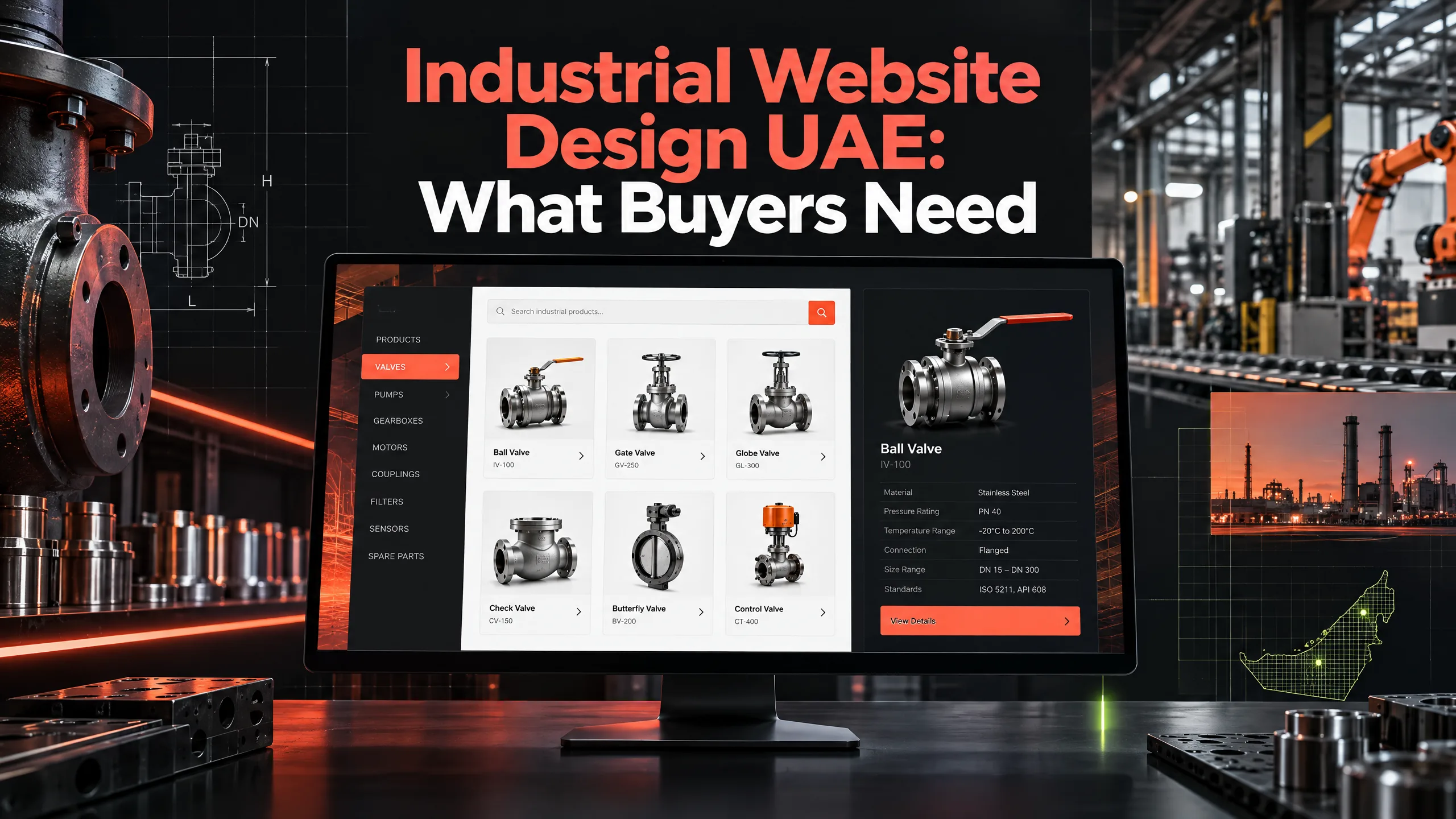
A manufacturer can have the right products, a folder full of technical PDFs, and twenty years of experience. A buyer may still leave the website without understanding which product fits the job.
That is the problem a industrial website design UAE project should solve. It is not mainly about putting a factory photograph behind a large headline. The site needs to help a technical buyer move from a requirement to a product, an application, a specification, and then a useful conversation.
The information is often already somewhere in the business. The hard part is putting it in the order a visitor can use.
An industrial website is not an online brochure
A brochure is usually read from the front. An industrial website is entered from many different places. Someone may land on a product page from search. A procurement manager may open a PDF from an email. An engineer may look for a specification during a site visit. A distributor may want a quick overview before passing a link to a colleague.
These visitors do not all need the same first answer.
A useful website gives them routes. Product pages connect to applications. Application pages point to relevant products. Technical documents sit beside a readable explanation. The enquiry button does not disappear after the first paragraph.
This is why B2B industrial website design needs more thought than a simple service-business template. The page structure has to support comparison, internal sharing, and questions that may take more than one call to answer.
Organise products around how they are used
A list of product categories is a start, not a buying journey.
Suppose a supplier sells pumps, valves, sensors, and control equipment. A visitor may not know the internal category name. They may be looking for equipment for water treatment, a replacement part for a production line, or a component that can handle a particular pressure or temperature.
The website should make both routes possible: browse by product, browse by industry, browse by application, compare relevant specifications, and ask about the right option.
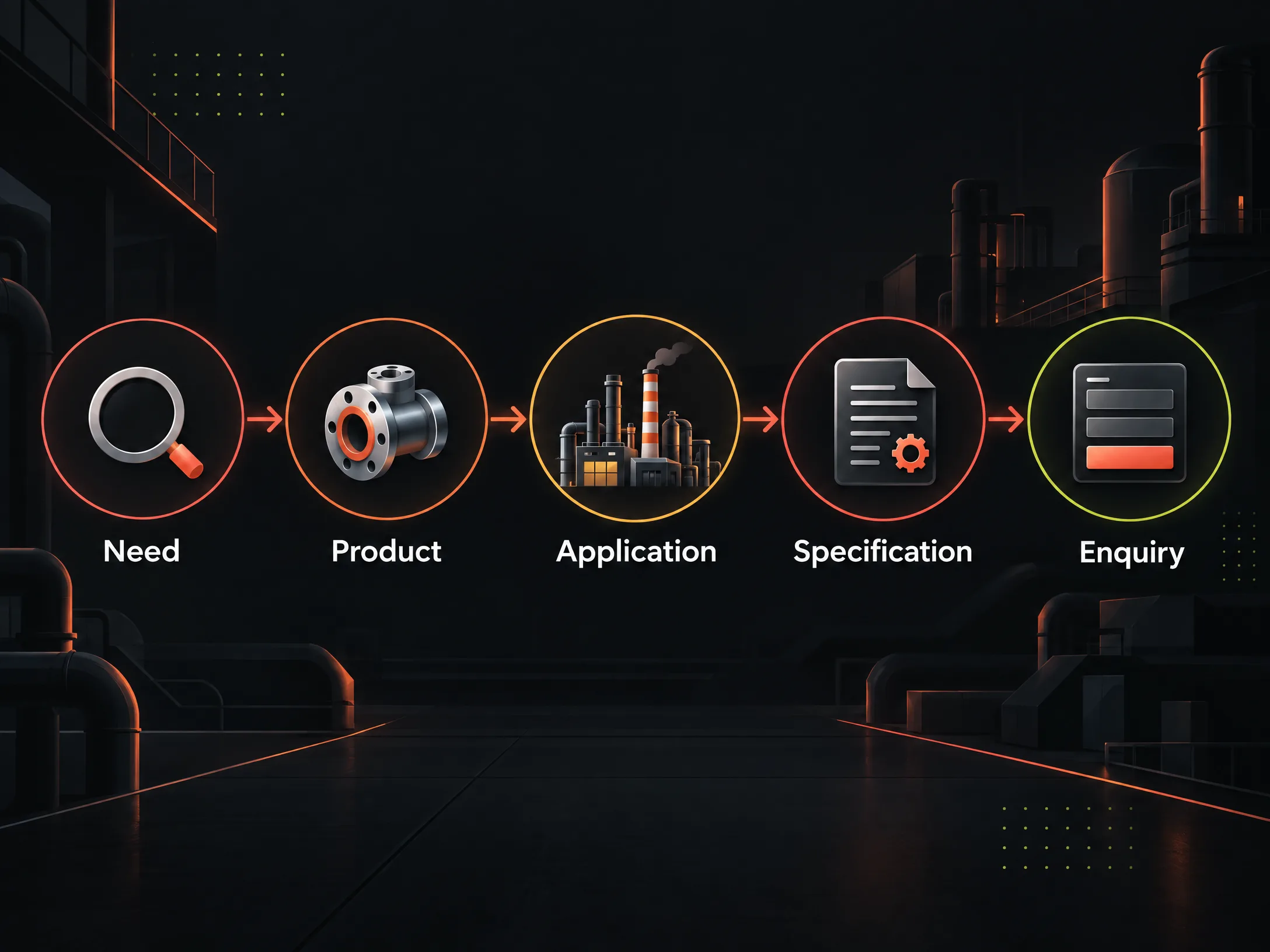
A simple relationship helps: product → application → industry → specification → enquiry. The exact labels will vary by business, but the principle holds. Do not make visitors understand the company’s filing system before they can understand the offer.
What belongs on an industrial product page?
A product page should answer the basic question before it asks the visitor to download anything. What is this? Where is it used? What should the buyer check before asking for a quote?
- A short description in plain language
- The main applications and industries served
- Important specifications and available variations
- Compatibility or operating conditions
- Drawings, certificates, or technical documents
- Related products and alternatives
- An enquiry path that keeps the product context visible
A specification table is useful when it is readable. A PDF is useful when the buyer genuinely needs the full document. Neither should replace the first explanation on the page.
This is where industrial website development UAE becomes more than a visual build. Product data, document ownership, enquiry handling, and update responsibilities need to be understood before the pages are assembled. Otherwise the website starts with attractive layouts and ends with empty boxes waiting for information nobody has approved.
Technical content can be clear without becoming childish
Technical buyers do not need every sentence simplified. They do need the page to respect their time.
Define an acronym when it first appears. Put the main use case near the beginning. Break a long specification list into useful groups. Say what a number means instead of placing it in a box with no context. If a condition or compatibility point still needs confirmation, say that plainly.
A page can be technically accurate and still be difficult to read. That usually happens when the copy has been lifted from an internal document without being shaped for the web.
An engineer may want the tolerance and material grade. A procurement manager may first want to know whether the supplier handles the relevant application. Both should be able to find their next answer without scrolling through a wall of company history.
Create paths for different buyers
An industrial website often serves more than one person during the same purchase. The first visitor may be researching options. Another person may check the technical fit. Someone else may approve the supplier or request the commercial details.
That does not mean creating thin pages for every job title. It means making important information visible from more than one sensible route.
A product page can link to its applications. An application page can explain the problem and show suitable products. A case study can identify the industry and the work completed. A document library can sit beside the pages that give the documents meaning.
Good engineering website design UAE should make those connections obvious. A visitor should not have to use site search for information that belongs in the main navigation.
Show proof that a technical buyer can use
Client logos alone do not explain much. “Trusted by leading companies” is a claim, not evidence.
Industrial buyers are more likely to value a short, specific account of the work. What was the application? What was difficult? Which product or service was supplied? Were there delivery, compatibility, or site conditions to consider? What can be confirmed about the result?
The answer does not need to reveal confidential figures. A clear description of the situation is already more useful than a sentence about excellence.
Use certifications, test information, project photographs, drawings, and named capabilities carefully. Every claim needs an owner inside the business. If the information is old, the page should not quietly present it as current.
Make the enquiry useful from the first message
A generic Contact Us button is easy to add and easy to ignore. A better enquiry route helps the buyer ask the right question.
For a product enquiry, the form may ask for the product name or code, application, quantity, location, timing, and a short description. Do not ask for all of these fields by default if the buyer may not know them yet. A supplier should make it possible to say, “I am not sure which product I need.”
The form should explain what happens after it is sent. Will someone check the requirement? Is a drawing or specification useful? Is the first reply likely to be a clarification rather than a price?
That honesty improves the quality of the conversation. It also supports industrial website conversion better than a bright button surrounded by vague promises.
Mobile matters in industrial buying too
It is easy to assume industrial research happens on a large office monitor. Sometimes it does. It also happens between meetings, during a site visit, in a warehouse, or while someone is forwarding a product link from a phone.
A mobile review should check more than whether the homepage technically fits the screen. Read the product introduction. Open a technical document. Use the menu. Tap the enquiry button. Try to read a table without zooming sideways.
Large product images should not push the useful information too far down. Buttons need enough room to tap. Contact details should not be hidden in a decorative footer.
SEO should follow the information model
Industrial SEO becomes difficult when every product page tries to rank for the same broad phrase. Give each page a real job instead.
A product page can target the product and its application. An industry page can explain the sector-specific problem. An application page can connect the need to suitable products. Supporting articles can answer questions that do not belong on a product page.
Use clear titles, useful introductions, logical headings, internal links, descriptive image text, and accurate structured data where it applies. Keep the visible page aligned with the search intent. Do not add an industry name to a thin duplicate page and call it a content strategy.
The sitemap, canonical URLs, redirects, and indexability checks matter as well, especially when an old catalogue is being reorganised. A well-written page that search engines cannot access has a different problem.
Questions buyers ask about industrial website design
What should an industrial website include?
It should usually include clear product groups, product details, industries or applications served, technical information, useful documents, supported proof, a visible enquiry route, and links that help buyers move between related information.
Why do industrial websites need application pages?
Application pages show where a product or service fits. They help a buyer who knows the problem but does not yet know the supplier’s internal product categories. Each page should contain real information and connect to relevant products.
How can a manufacturing website generate better enquiries?
A manufacturing website design UAE project can improve enquiries by explaining product fit, showing the information a buyer should provide, keeping product context in the form, and making the next step clear. Adding more fields is not the same as improving qualification.
Should a UAE manufacturer create separate industry pages?
Only when each industry page has a distinct audience question, useful information, and genuine links to products or applications. Pages that simply replace the industry name in the same paragraph are unlikely to help buyers or search visibility.
Before approving the next website layout, ask someone unfamiliar with the product range to find the right option for a stated application. Do not explain the navigation while they do it. Notice where they stop, what they search for, and which information they expect to see next.
That small test will tell you whether the site is helping a technical buyer—or asking the buyer to do the organising work.